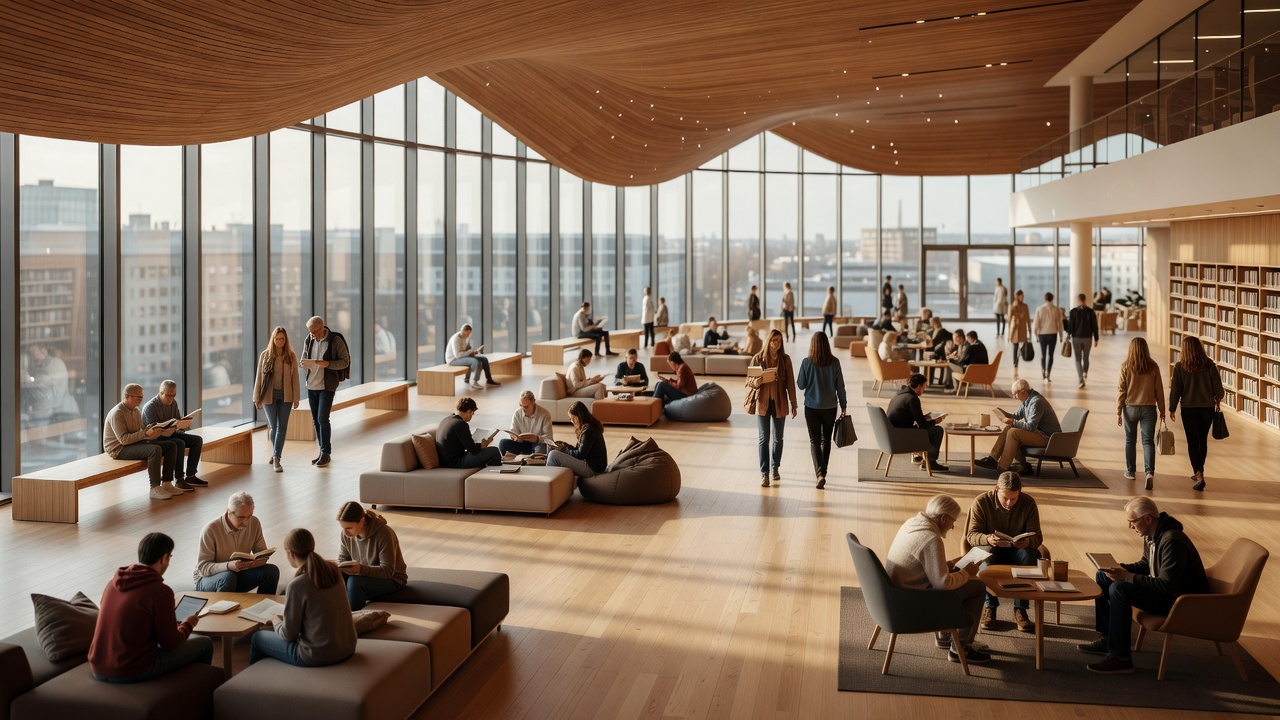
Public life is more than a busy photograph
A crowded square can still exclude people. A quiet reading room can be a deeply valuable public place. Counting visitors tells only part of the story; the more revealing questions concern choice. Can someone arrive alone, stay without buying anything, find a toilet and leave without negotiating an event or commercial threshold?
Architecture helps establish these possibilities, but operation sustains them. Opening hours, staffing, cleaning, booking systems and the treatment of young people all affect whether a space feels genuinely shared. A welcoming staircase cannot compensate for an unclear entrance policy. Equally, a modest building can become an important civic resource through generous management.
Oodi: different activities under one roof
Helsinki Central Library Oodi is useful because its public purpose is not confined to borrowing books. Reading, making, meeting and cultural activity sit within a larger civic institution. The architecture gives different activities different settings rather than asking one undifferentiated hall to absorb every sound and movement.
For a visitor, this raises a practical question about legibility. Can you understand where a lively activity belongs and where quieter occupation is possible? Look at the change in atmosphere between floors, the availability of staff and the relationship between lifts, stairs and destinations. A generous building still needs clear wayfinding.
Oodi should not be reduced to its flowing exterior or timber surfaces. Its civic value also lies in the less photogenic systems that support access to resources. Equipment and rooms may require bookings or have specific conditions, so “public” should not be read as “every service is immediately available to everyone.” Check the library’s current guidance before arranging a particular activity.
Dokk1: a library within a wider daily routine
Dokk1 in Aarhus, designed by Schmidt Hammer Lassen and opened in 2015, combines a library with citizen services and other public functions. This overlap matters because people arrive with different intentions. One visitor may be dealing with an administrative task while another is meeting a friend or bringing a child to explore.
Study the edges between these uses. A good shared institution allows movement without making every route feel like a queue. Seats near circulation can support brief pauses, while more protected areas can encourage longer stays. The design challenge is to offer these alternatives without making a newcomer decode the building like an insider.
The waterfront context is important, but so is the ordinary approach from the city. A public institution succeeds through connections to transport, walking routes and daily errands, not merely through an impressive isolated setting. Notice where a comfortable journey begins and where it becomes dependent on signage, staff help or prior knowledge.
Amos Rex: museum space and public ground
Amos Rex, designed by JKMM and opened in Helsinki in 2018, places exhibition spaces below Lasipalatsi Square. Its raised roof forms make the presence of the museum visible in the public surface above. The resulting relationship between cultural institution and outdoor ground is worth studying separately from any particular exhibition.
People may encounter the square without entering the museum. That is a genuine civic distinction: an institution can contribute to public life beyond its ticketed rooms. Yet an expressive landscape is not automatically an equally usable surface. Look for the ordinary, level routes around sculptural features and consider how wet weather, snow, supervision and crowding alter the experience.
A small observation method
Choose a position that does not obstruct anyone and watch for a few minutes. Record activities rather than identities: waiting, crossing, reading, playing, resting. Do not photograph identifiable people without appropriate permission, and avoid drawing conclusions about someone’s circumstances from appearance.
Then note what the building provides for each activity. Is a person sitting because a seat was offered, or balancing on an edge because no suitable seat exists? Are people gathering because circulation is generous, or because an entrance is blocked? The same visible behaviour can indicate either successful provision or a workaround.
Finally, return in different conditions if possible. The lunchtime impression is not the evening impression; summer openness is not winter comfort. Public value is a continuing relationship between design, care and use. Treat your first visit as a question, not a verdict.